
What is Endoscopic Spine Surgery?
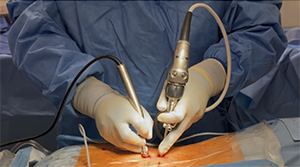
Endoscopic spine surgery is a minimally invasive spine surgery technique.
Endoscopic spine surgery aims to perform same procedure as traditional open surgery, but through a less invasive means.
The main component of endoscopic spine surgery is utilizing a specialized camera to view inside the spine; all using the smallest incision possible.
Instruments can be placed in the same incision as the camera (uniportal) or placed in a separate incision; thus, two incisions (biportal).
Indications of Endoscopic Spine Surgery
Endoscopic spine surgery is considered as a last resort for treating spinal conditions in the neck and back when conservative treatments have failed to improve your symptoms. Various conditions can be treated endoscopically including:
- Degenerative disc disease
- Herniated discs
- Sciatica
- Stenosis
As endoscopic spine surgery has progressed, it can now be used to treat:
- Spinal infections
- Spinal tumors
- Spinal instability
- Spondylolisthesis
- Revision spine surgery
Pre-procedure Preparation for Endoscopic Spine Surgery
Before the procedure, your surgeon may advise you to stop smoking and to exercise regularly to improve your recovery rate. Any non-essential or herbal medications that increase surgical risk should be discontinued before surgery. Before your surgery, you can ask your surgeon any questions that you may have. Any drugs such as NSAIDs, aspirin, elliquis, Plavix need to be stopped so bleeding does not occur during the procedure. You should check with the doctor who prescribed those drugs to make sure you can stop the drugs safely.
Endoscopic Spine Surgery Procedure
Endoscopic spine procedures are performed using a tool called an endoscope, a thin tube with a tiny video camera on the end of it. The camera displays the images of the inside of the body onto the television screens, helping your doctor view the operating site. Surgical tools are placed in the same incision as the camera (uniportal) or in another incision (biportal).
Post-procedure Protocol
With endoscopic spine surgery, you will go home the same day of surgery in the vast majority of cases. Physical therapy and occupational therapy are recommended to mobilize the spine and loosen the muscles after your soft tissues heal. Therapy is usually started 6 weeks after surgery. Until then, Dr Park recommends you walking as much as possible and try to avoid bending, lifting and twisting for the first 2 to 4 weeks. You will have drainage of fluid for a few days after surgery. This is normal. If you have clear fluid drainage with headaches please contact Dr Park.
Benefits of Endoscopic Spine Surgery
Traditional open surgery typically requires a larger incision, muscle stripping, longer hospitalization and increased recovery time. The advantages of endoscopic procedures when compared to the traditional procedures include the following:
- Small incision and minimal scar tissue formation
- Less blood loss
- Less damage to the surrounding tissues
- Faster recovery
- Quick return to normal activities
- Decreased hospital stay
- Less postoperative pain
- Reduced risk of infection
- Improved function
Furthermore, we can precisely pinpoint and treat and problem
Risks and Complications of Endoscopic Spine Surgery
Like any type of surgery, there are certain risks associated with endoscopic spine surgery, such as:
- Reaction to anesthesia
- Blood clots
- Blood loss
- Infections
- Nerve injury (including weakness and very rarely paralysis)
- Need for additional surgeries
- Pain
- Swelling of the surrounding soft tissues
- Leakage of spinal fluid causing a headache